What's Still Being Built on Vineyard Avenue, Next Door to Ruby Hill
Two housing projects on Vineyard Avenue moved through Pleasanton's planning pipeline in September. One is 27 homes near Thiessen Street. The other is three homes beside the Vineyard Avenue trail. Together they are among the last pieces of a corridor that has been filling in for more than two decades. Both projects follow land-use limits set in the 1990s, and those limits trace back to Ruby Hill itself.
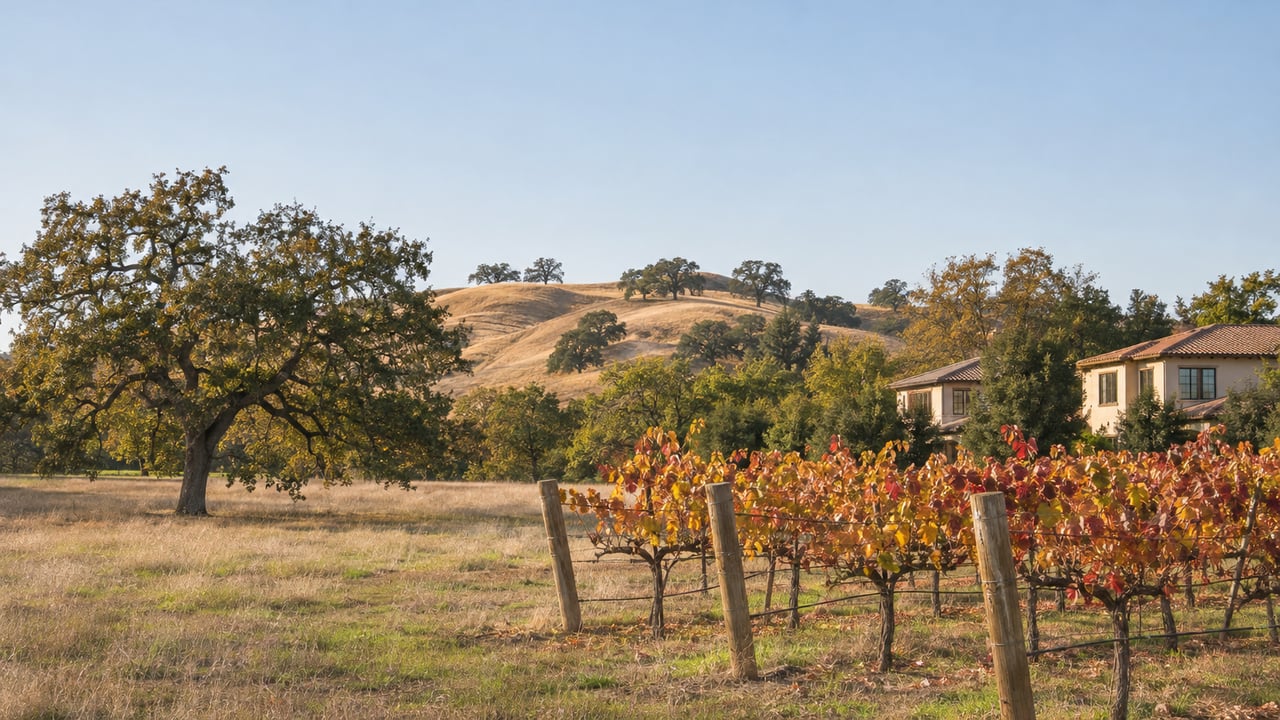
The larger project is the one Trumark Homes markets as Vintage Estates. In city records it appears as the PUSD Vineyard site, because the Pleasanton Unified School District owns the land. The Independent reported that the 10.6-acre parcel runs between Thiessen Street and Manoir Lane along the city's eastern urban growth boundary. Each home would run about 3,300 to 3,500 square feet, with a two-car garage, a one-car garage and a 600-square-foot accessory dwelling unit.
The site plan should look familiar to anyone who drives that stretch of road. The City of Pleasanton's Community & Economic Development update dated Sept. 16, 2026 lists the project as approved. It has 27 single-family homes, a park lot of about 0.65 acres at the back of the site, and a separate lot of about 2.35 acres for a vineyard and bioretention areas. According to The Independent, the design was revised after neighborhood feedback to keep the area's wine-growing look along Vineyard Avenue and to move children's play equipment farther back from the road. As of the Sept. 16 memo, Public Works was reviewing the final map, and the Building and Safety Division was reviewing grading and building permits. Trumark Vice President of Community Development Robin Miller described the company's pace to The Independent in four words: "We are rushing to the starting line."
The smaller project sits at 1 Brozosky Hill Lane, on the south side of the Vineyard Avenue trail. Pleasanton Weekly reported that it came before the Planning Commission on Sept. 23. The plan keeps the existing home on a 17.2-acre remainder and places three new homes on 2.8 acres of the original 20-acre site. The new homes would face the trail, share part of the existing driveway, and be reached by a private access easement. Staff recommended that the Commission send it to the City Council with a recommendation to approve.
In the staff report, the number of homes comes from the corridor plan's map of home sites.
"The VACSP Land Use Plan identifies general home locations for each site within the VACSP, referred to as the 'blob areas.' The proposed project proposes to group the identified house locations, or 'blobs', for less hillside disturbance."
That is city associate planner Jenny Soo, quoted by Pleasanton Weekly. The site is known as Lot 24. The plan identified three new homes for it in addition to the existing residence. That count was set before the current owner ever applied.
VACSP stands for the Vineyard Avenue Corridor Specific Plan. Pleasanton adopted it in 1999 when it annexed the area. According to an October 2023 special study by Alameda LAFCO, the plan covers 384 acres on both sides of old Vineyard Avenue, south of the Arroyo del Valle and west of Ruby Hill. The plan assigned districts, minimum lot sizes and caps. Pleasanton Weekly noted that the city has spent the last decade approving projects like Brozosky Hill Lane, one plan site at a time.
Here is what the plan allowed next to what the LAFCO study counted on the ground in 2023:
| What the 1999 plan provided | What existed as of the October 2023 LAFCO study | |
|---|---|---|
| Homes | 189 new homes plus 18 already there | About 168 homes |
| Hillside Residential | 19 homes on lots of at least 40,000 sq ft, clustered, with surrounding open space preserved | Included in the total above |
| Low-Density Residential | 79 homes on lots of at least 20,000 sq ft, south of Vineyard Avenue | Included in the total above |
| Medium-Density Residential | Up to 85 homes on lots of at least 10,000 sq ft, in a "vineyard village" design | Included in the total above |
| Vineyards | 66 acres on five lots, each allowed one estate home | About 30 acres of vineyard or other crops |
| Civic uses | A community park and an elementary school | Neither built |
By 2006, according to the study, most of the homes had been built or approved, and Vineyard Avenue itself had been moved onto a new alignment. The old roadbed did not go back to traffic. A city staff report in a Pleasanton Planning Commission packet says the city converted the Old Vineyard Avenue right-of-way into a Class 1 multi-use trail in 2017. That is the trail the three Brozosky Hill Lane homes would line up along.
Compared with the plan, homes came in close to their ceiling and vineyards came in at less than half their target. A vineyard needs a grower willing to plant and farm it year after year.
Today Ruby Hill is centered on The Club at Ruby Hill, at 3400 West Ruby Hill Drive. The LAFCO study tells an earlier story that explains the land on both sides of the community.
In 1991, Alameda County approved Ruby Hill as an unincorporated master-planned community with 850 homes, a golf course and a retail site. The City of Livermore sued the county and the developers over that approval. The case ended in a four-way development agreement among Pleasanton, Livermore, Alameda County and the Ruby Hill developers. Its terms still shape the view from most Ruby Hill windows:
According to LAFCO, the same settlement led the county to write its South Livermore Valley Area Plan, adopted in 1993. That plan created the Vineyard Avenue transitional area, and its policies called for development there to "provide a graceful transition between existing urban areas and the adjacent vineyards area." The 1999 corridor plan, the "blob areas" and Lot 24's three homes all follow from that 1993 plan.
Ruby Hill broke ground in 1993. LAFCO describes it today as essentially complete, with 850 homes, an 18-hole course, about 280 acres of vineyard and vineyard-related land inside and next to its boundaries, and 91 acres of open space. The club itself sits on about 225 acres.
The settlement also fixed what lies east of Ruby Hill. As part of the agreement, Livermore annexed 694 acres directly east of the community, known as Vineyard Estates. The study says the purpose was an urban limit that would stop Pleasanton's urban area from spreading farther east. Vineyard Estates was divided into thirty-two 20-acre parcels. Each one has been planted with vineyards and built with a single estate home.
Put the three areas side by side and Ruby Hill sits between two planned edges. To the east, 20-acre vineyard parcels each carry one house. To the west, the corridor plan identified home sites in advance. Brozosky Hill Lane proposes the three homes identified for its lot in the plan, and Vintage Estates sets aside more of its acreage for vineyard and bioretention than for the park.
Land farther into the valley follows similar rules. Our earlier look at South Livermore vineyard acreage covers the county's 90/10 rule. For questions about Ruby Hill itself, our Ruby Hill neighborhood page and our post on where the school-district line falls in Ruby Hill pick up where this post stops.
The two projects to watch this winter are Brozosky Hill Lane, where the City Council makes the final decision on the subdivision, and Vintage Estates, which needs its final map and grading permits before work starts on the Thiessen Street parcel.
If you own in Ruby Hill or along Vineyard Avenue and want to know how new homes nearby factor into your home's value, the team at McGuire Olson Real Estate can walk you through it. Request a complimentary market consultation.
McGuire Olson Real Estate are responsive, enthusiastic, and professional. They have built a solid reputation and a vast network of local connections to aid and assist their clients in every aspect of their transactions.
Tim McGuire | CA DRE# 01349446
[email protected]
Lori Olson | CA DRE# 02004247
[email protected]
925.517.MORE (6673)
900 Main St STE #101 Pleasanton CA 94566